
In my previous posts, I explained how I was stuck in the Running Plateau and the science-based training approach that helped me break through it. I explained in detail about zone-based training, proper recovery, intervals, and structured periodization that I incorporated into my training once I understood the science behind how to run.
However much you argue that process is important, others care about the results. This post actually goes over the numbers that matter!
Let’s be real: MS Dhoni can say all this gyan about process only because he led CSK to become THE most successful team in IPL history. Thanks for the amazing 18 seasons, Thala!
Improved Pace: The 10K
Let’s start with the headline number – my 10K pace progression over the years:
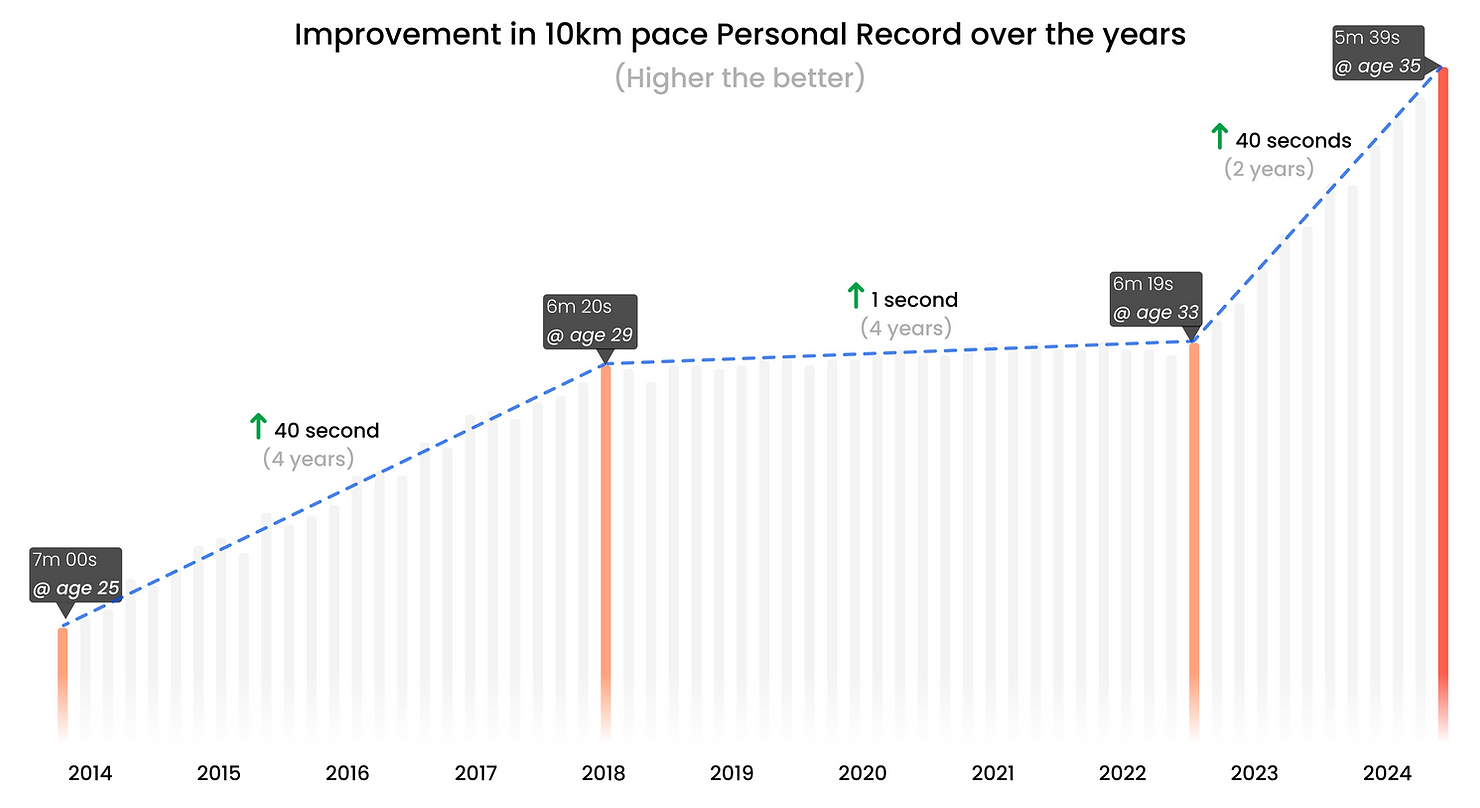
Looking at my 10K progression:
- 2014-2018: 7:00 → 6:20 (The Youth: 40-second improvement in 4 years)
- 2018-2021: 6:20 → 6:19 (The Plateau: 1-second improvement across four calendar years, despite 474 runs covering 2,464 km)
- 2022-2024: 6:19 → 5:39 (The Wisdom: a further 40-second improvement in 2 years)
After four years of stagnation during which I improved by just one second, I suddenly shaved off 40 seconds in half the time – and this happened in my mid-30s, when conventional wisdom suggests we should be slowing down.
As I mentioned in the previous posts, I was training at a lower intensity most of the time. My OG “no pain, no gain” approach would have predicted the opposite result.
Improved Efficiency: Better Pace at the Same Effort
What I find most satisfying is seeing how my pace improved while I maintained the same heart rate:
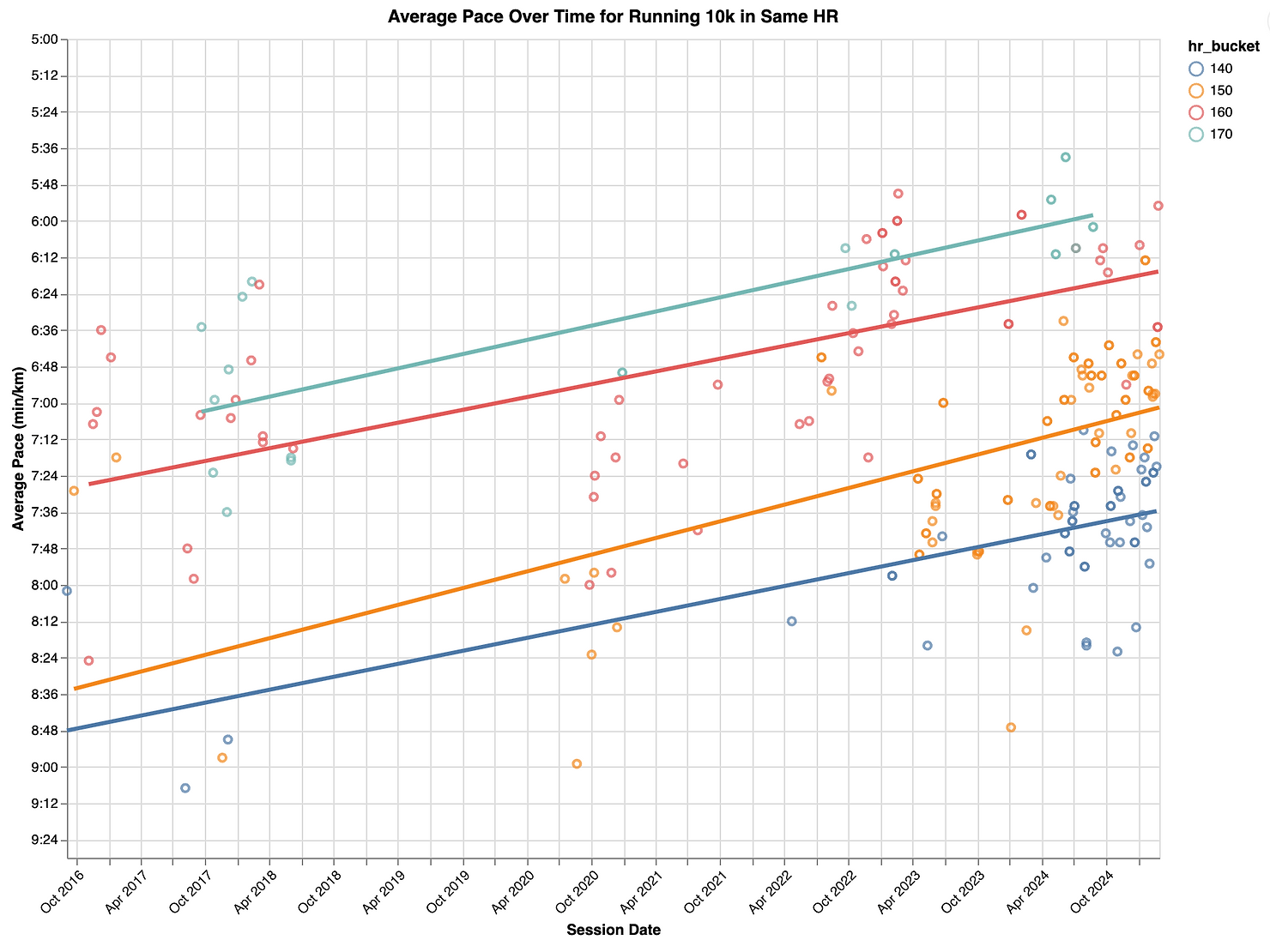
My average pace improved over time at every effort level, from my easiest (140 bpm) to my hardest (170 bpm).
The colored lines represent different heart rate zones. Notice how at the same heart rate (e.g., 140 bpm), I’ve been able to run progressively faster over time. The same speed that needed a 170 bpm effort now happens at 140-150 bpm, causing much lesser cardiovascular strain and recovery needs.
Realizing REAL Consistency
Prior to 2022, I thought I was already quite consistent with my running. I’d show up 2-3 times a week and feel proud of how consistent I was. But the data tells a different story:
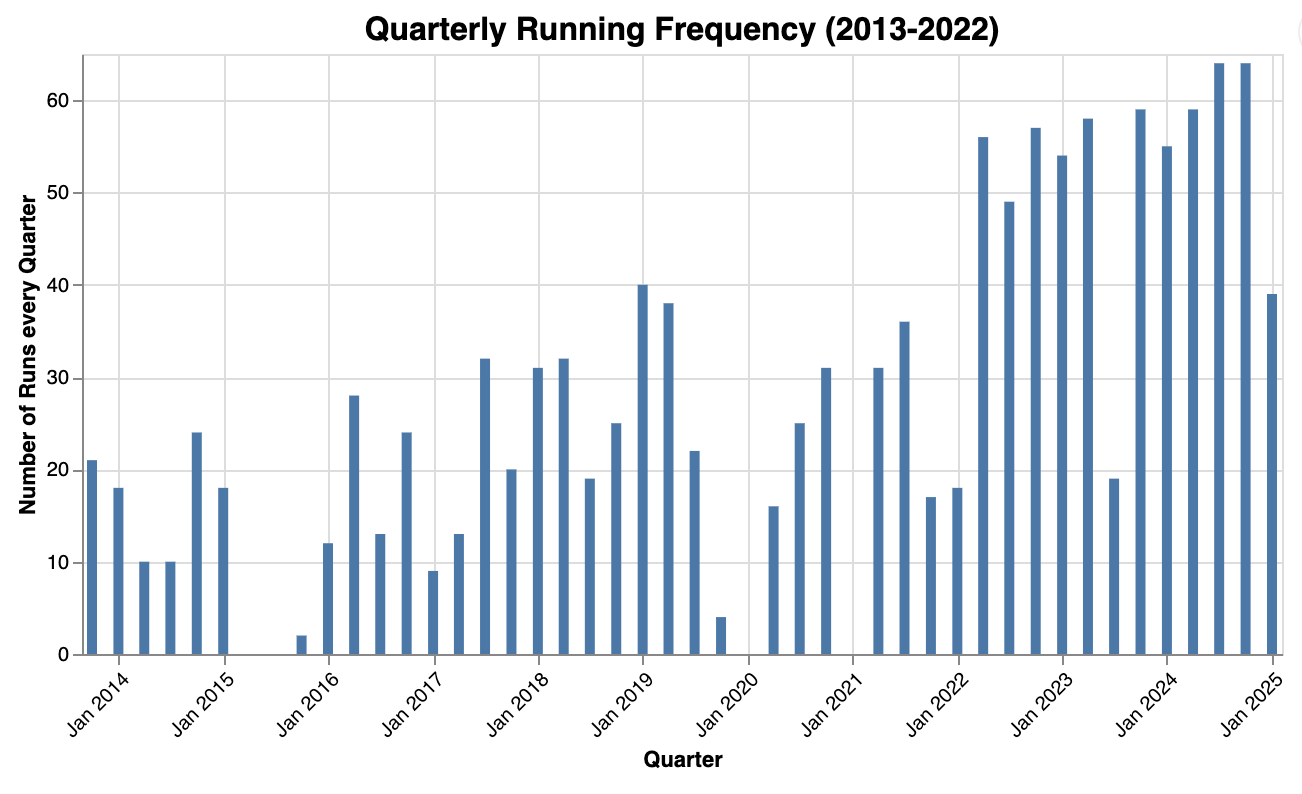
The chart shows my running consistency and distances from 2016–2025. The “consistent” training pre-2022 looks all over the place compared with what became possible with proper zone training.
As I explained in the previous post’s section on recovery, I couldn’t run as frequently because I was often sore, and when I did run, I wasn’t fully recovered.
Endurance: The HM
My half marathon performance shows how much my endurance had also improved:
2017 Half Marathon (age 28):
- Time: 2:46 - 7:59/km pace (slowwwww)
- Average HR: 170 bpm
- Run pattern: Positive split (started fast, crashed hard)
- Recovery: Multiple days of downtime where I couldn’t run more
2025 Half Marathon (age 36):
- Time: 2:08 - 6:07/km pace (decent, world average pace :P)
- Average HR: 165 bpm
- Run pattern: Even split (finished as strongly as I started)
- Recovery: Next run, a recovery run within 24 hours
I was 38 minutes faster over 21 kilometers, while running with a lower heart rate, feeling better throughout, and recovered more quickly – even though I was 8 years older at this time!
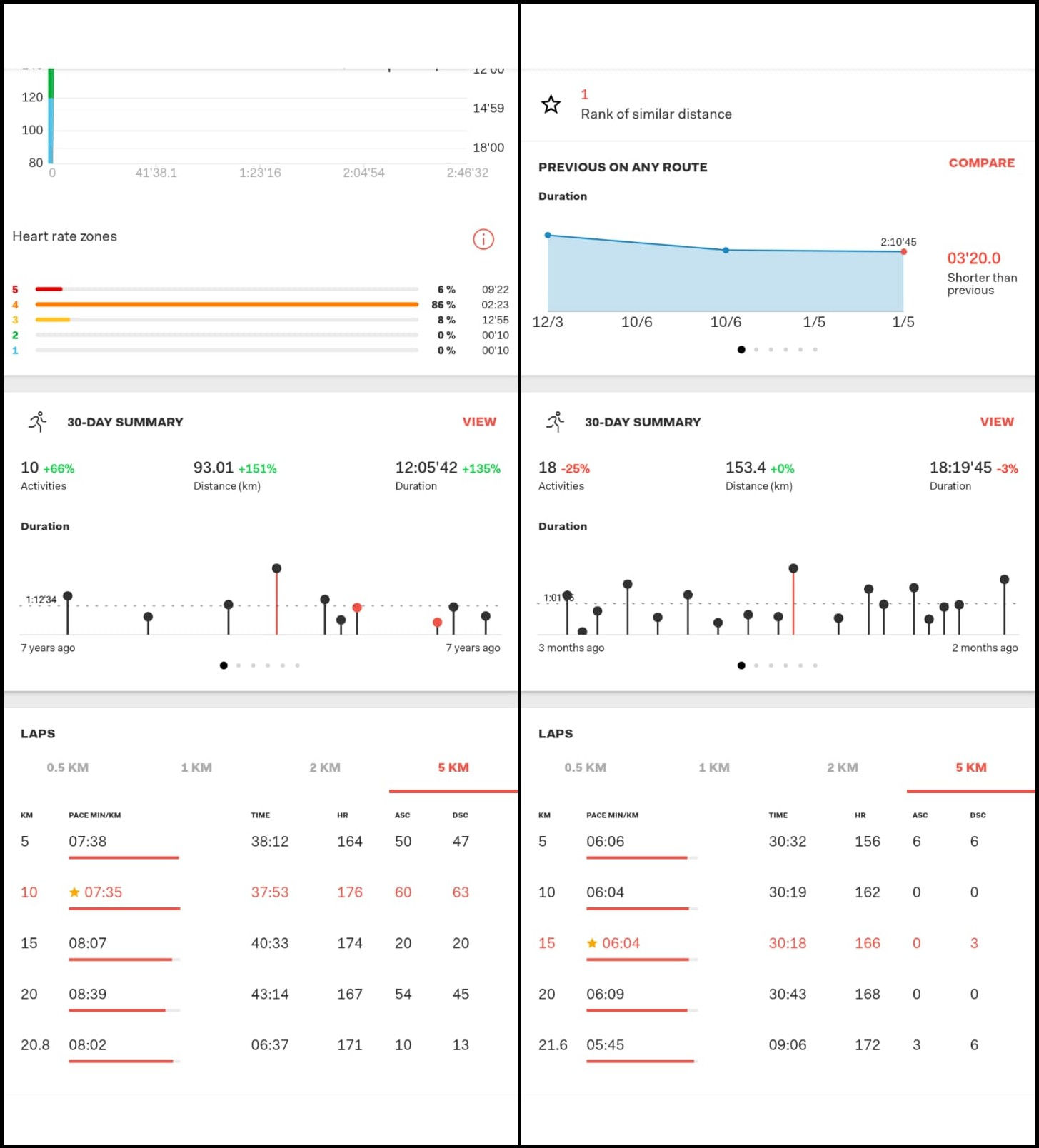
Within that run, look at my 5K splits:
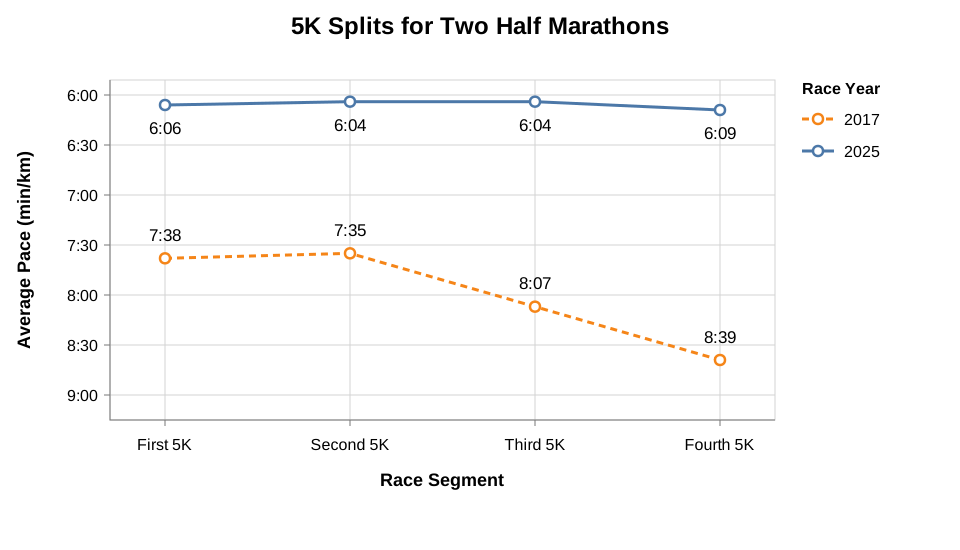
The blue line is so pretty and symmetric! The 2017 race shows the classic “positive split” pattern of someone who hasn’t built adequate endurance. You start too fast and gradually slow down as fatigue sets in. The 2025 race was run by someone who had become a runner.
Not to Forget: Cookie Economics
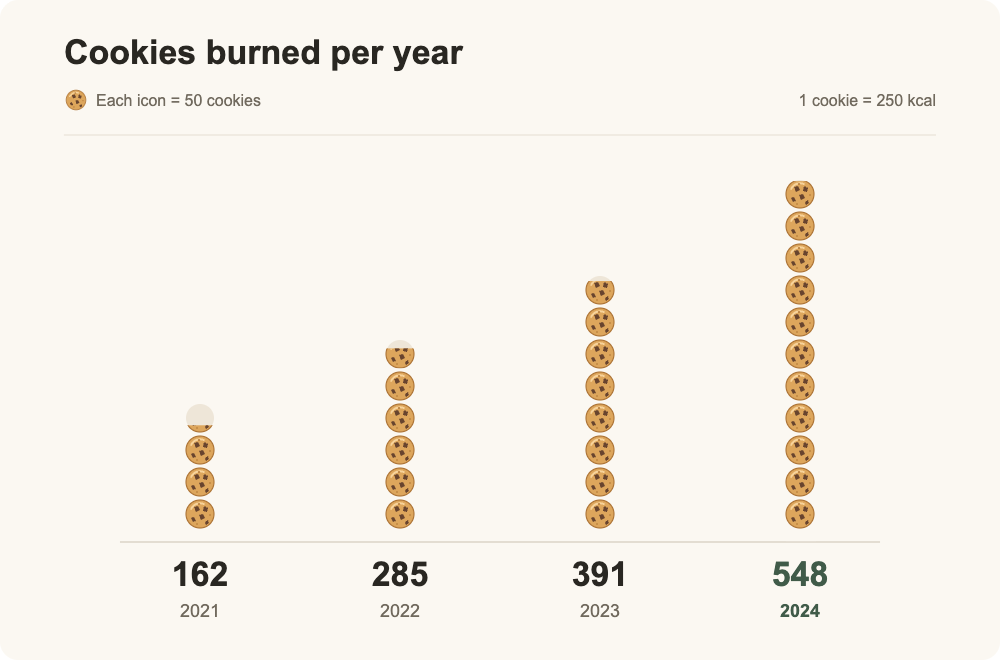
The original reason that I took up running was to burn calories so that I could eat more! The running efficiency improvements really helped me increase the total calories burned. Here’s a fun visualization of the “cookie dividend” my running has paid over the years:
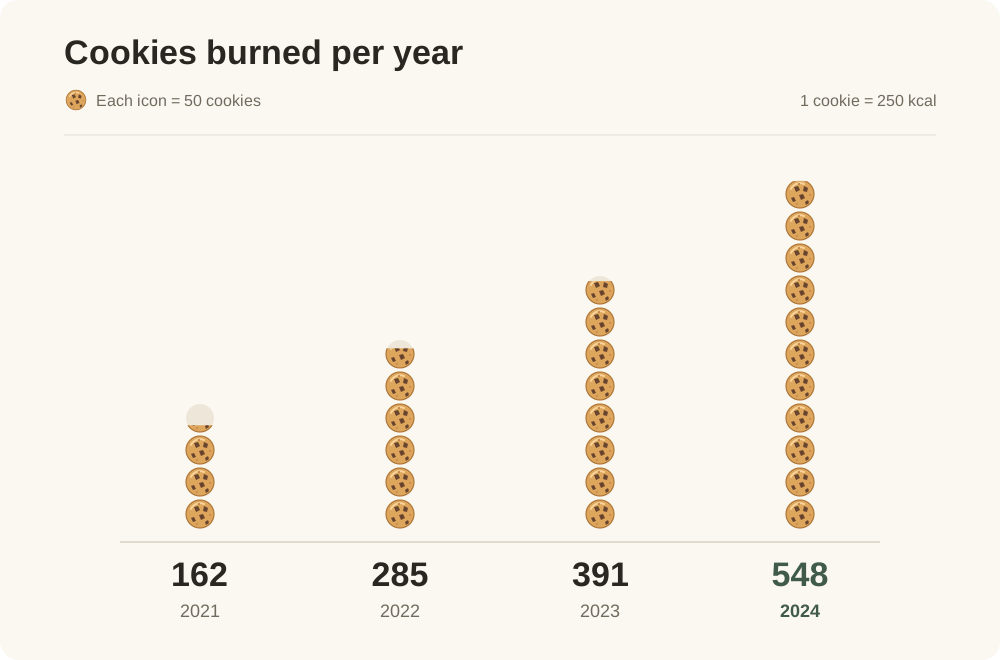
Notice the increase in yearly totals from 2022 onward. The improved efficiency allowed me to run longer distances more frequently without burning out resulting in a huge gain in calories burned.
- In 2021, burned approximately 40,500 calories through running (162 cookies)
- In 2023, burned approximately 97,750 calories (391 cookies)
- In 2024, that increased to 137,000 calories (548 cookies)
That’s an extra 386 cookies per year I can enjoy without weight gain!
Beyond Numbers
What cannot be captured in all the analytics and charts is how my relationship with running has changed over the years. Running was once something I forced myself to do – a necessary evil for fitness and food. Today, it’s something I genuinely enjoy.

Picture taken at the 20th km of Bengaluru Half Marathon 2024, a different race from the 2025 comparison above. Seven years earlier, this same point would have found me grimacing with fatigue rather than grinning for the camera.
Since Then: Breaking the Sub-2 Half Marathon
The numbers above (and the original post, which I have updated) are from 2024/25. Since then, I have broken the sub-2 half marathon barrier at the 2026 Bangalore HM. This is what prompted me to bump this post again.
2026 Half Marathon (age 37):
- Time: 1:59:21 (recorded watch/GPS pace: 5:41/km)
- Average HR: 165 bpm
- Run pattern: Even(ish) split (could have paced this better, but still, the result stands!) ;)
- Recovery: Recovery run within 24 hours
You Can Do This Too!
If you are one of those who think that “runners” are a different breed and you can never become one, I hope that my blog helps you into giving running another chance - If you’re dreading runs rather than looking forward to them, consider that the approach – not your potential – might be the limiting factor.
Comments