
I get asked a lot why I am such a big proponent of zone training and why it works better than other training patterns. All I know is that this is something that has worked great for me, and I am hoping that it helps others too. In this series of blog posts, I will try to tell my story of how I learned to run better.
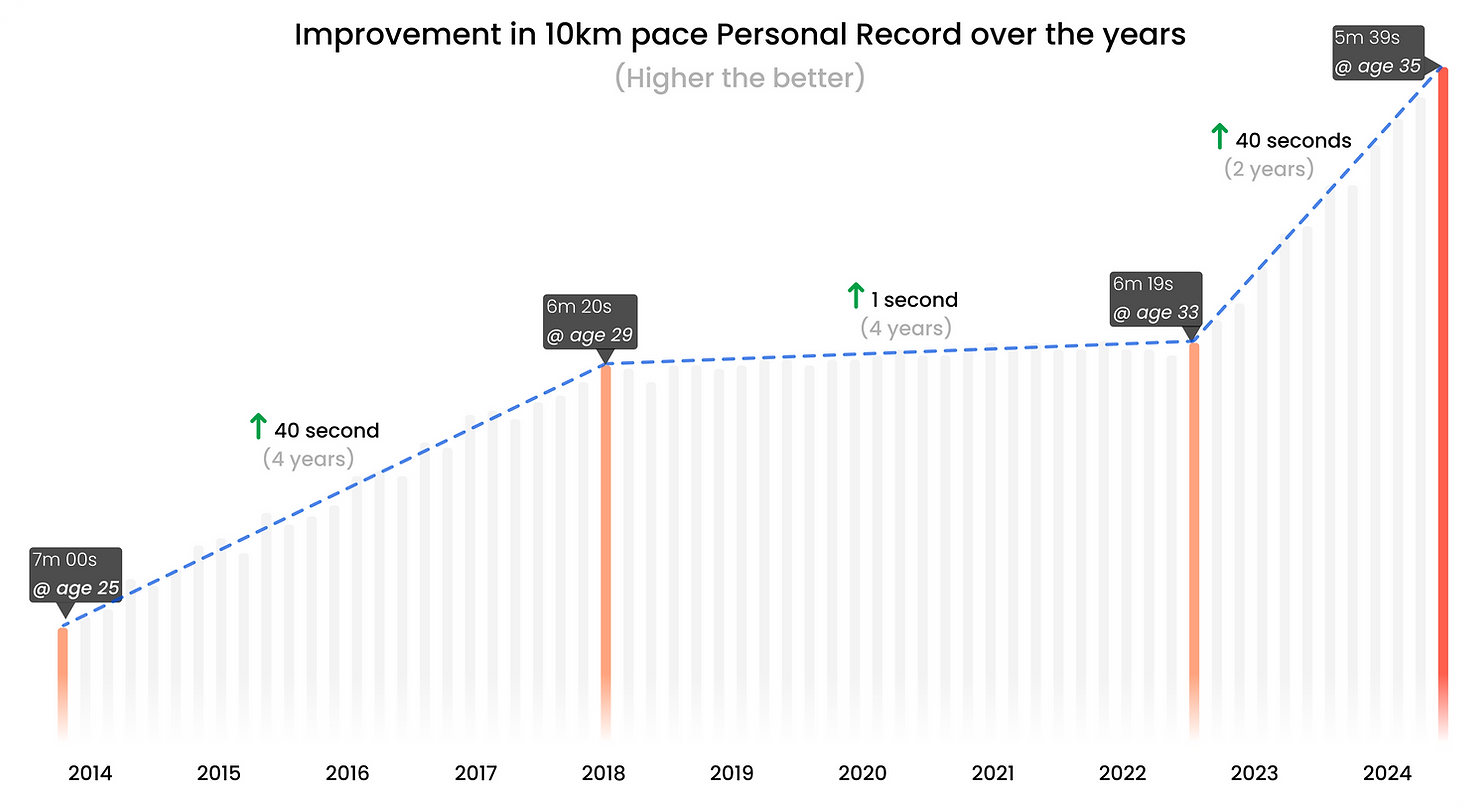
I have always stored my data (my spouse calls me a “chronicler”), so I can tell you the exact numbers: after 8 years, 728 runs and 3,850 kilometers, my 10K time stayed the same for nearly 4 years after an initial improvement. Then, in just the next two years, I slashed 7 minutes off that same distance.
I ran my first half marathon when I was twenty-eight, after about four years of running, and despite all of that I finished with a 2:46. There are people who have never run in their life (or have mostly played other sports) who come in and finish their first half marathon in under two hours. My case was never that. I wanted to write this for all the folks who are NOT natural runners, but want to get into running to show that the right science/data and consistent effort can make someone a good runner. If you are one of those who believe that “I am just not built for running!”, this is for you.
But let’s start from the beginning…
Runtime Error at the Boot stage
As a child, I used to love playing football, and I had decent ball skills. But my stamina was always lacking. While many of my friends (with the aforementioned athletic ability) maintained their energy levels throughout the game, I’d inevitably find myself taking a break after a few sprints. I was made for quick sprints and clever plays, not endurance. “Some people are born to run, and I simply wasn’t one of them.”

School days at Christ Nagar, Thiruvallom (circa 2004). The skinny kid on the left couldn’t run any distance to save his life. Two decades later, the three of us built Netrin together (more on that later). Pictured: Alex (CTO), Visakh (Chief of Staff) and Preejith (CEO)
The Caloric Equation Phase (2013-2016)
Fast forward to 2013, age 24. I am three years into my professional career (which I loved!), and I absolutely love food as well. This love affair has serious waistline consequences. If I was skinny in school, now I have become a more “well-rounded individual”, since sitting in front of a computer 12 hours a day, while having desserts every meal has predictable effects on one’s physique.
I realized I needed to burn calories to keep enjoying my food. Running was the obvious choice both because it was universally accessible (just shoes and a road) and time-efficient (maximum calorie burn per minute invested).
Of course, I needed a way to track my running from day 1. I have been using the trusty (and still awesome) SportsTracker app ever since, and it has faithfully recorded every step of my journey. The training plan was simple: faster equals better. Every run was just me trying to beat my previous time.
The story during this phase was simple:
- Consistent 5-6km distances on most runs.
- A rare 10K once in a few months when I am feeling my absolute best. Completely drained at the end of that.
- Steadily improving times for the first couple of years… until they weren’t.
The approach worked well initially. The novelty of improvement was addictive, and seeing my times drop provided a rush of accomplishment. Each run felt like I was achieving something, since I was gasping for breath at the end of the run.
What I didn’t realize then (though it seems obvious in hindsight) was that my approach had built-in limitations. I could only push myself to maximum intensity for relatively short distances. After these high-intensity sessions, I’d be wiped out for a day or two, limiting how often I could run each week (usually 3 runs at best).
The belief that you only get better by pushing harder had been ingrained in me since childhood. The fact that I couldn’t run on consecutive days was never an issue in my mind; it was proof that my previous workout was a good one. The idea that maybe I should run slower would have seemed completely counterintuitive (read: idiotic) to me at this point.
For now, I was simply enjoying the runner’s high and the guilt-free desserts that followed, blissfully unaware that my approach would soon lead me to a performance plateau. What’s fascinating in retrospect is that despite my unstructured approach, I had unknowingly established the most critical component of running improvement: consistency. I just had no idea how to make the most of it.
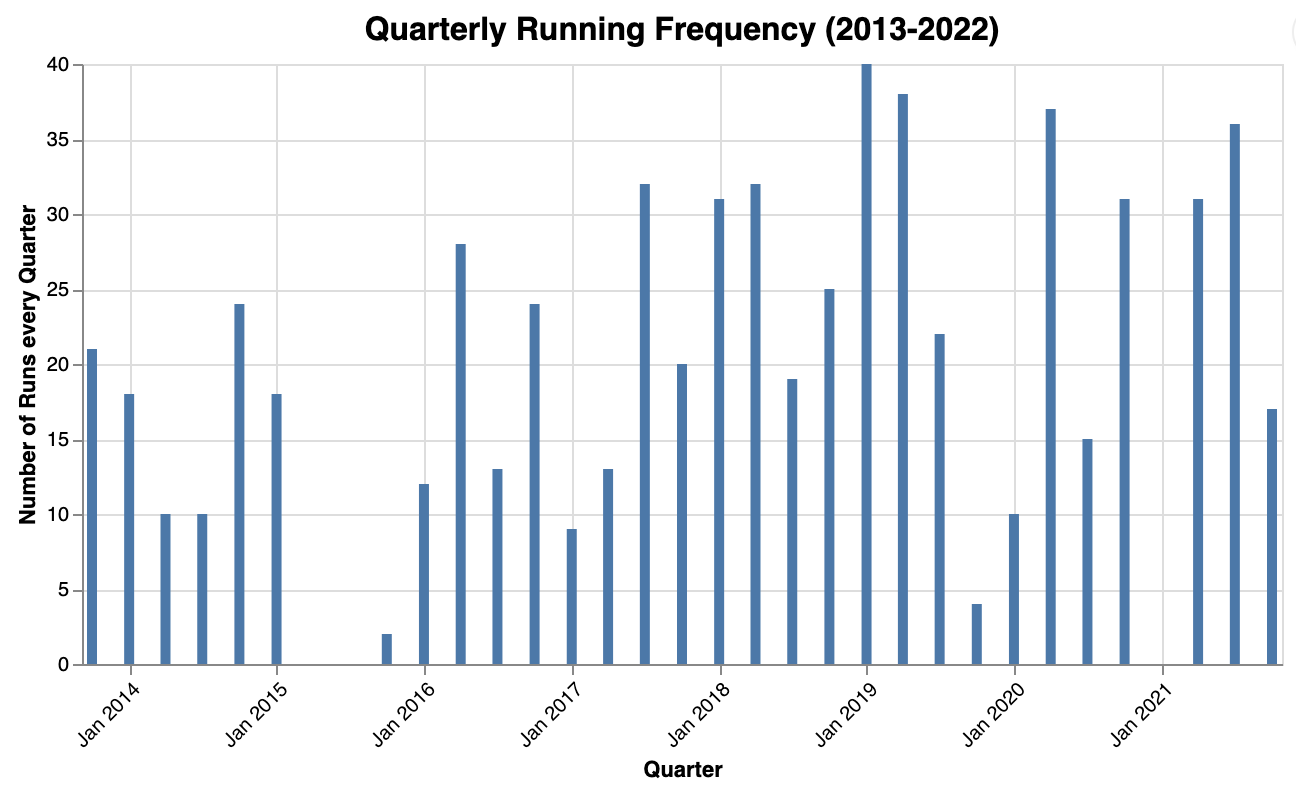
I was quite consistent for 8 years, except for a couple of quarters’ break due to injuries
The Half Marathon Experiment (2016-2018)
By 2016, I had grown confident enough in my running abilities to begin contemplating longer distances. Conquering a half marathon seemed like the logical next step. It feels like anyone can run up to a 10K, but only a Runner with a capital R can run a half marathon?
Maybe partially true.
My training approach remained the same, which was simply to push every time. However, I did increase the mileage of my runs from 5-6km to 8-10km. I also got my first heart rate monitor by this point (a Scosche armband which would stay with me for almost a decade), but I was using it more as a way to verify that I was pushing sufficiently than actually doing anything with the data.
Looking back at the data, my average heart rate even during training runs was consistently above 165 BPM. Today I know that this is upper “Zone 4” where sustainable cardiac endurance development becomes nearly impossible and recovery takes days instead of hours. But armed with my limited understanding and boundless determination, I pushed on.
On race day, I thought I started well, actually. However, I hit the proverbial “Wall” around kilometer 12, when my body (which had never really run more distance than that) decided that it was done. The second half was torture. I crossed the finish line at 2:46, a time in which strong amateur runners (not even elites) finish a FULL marathon.
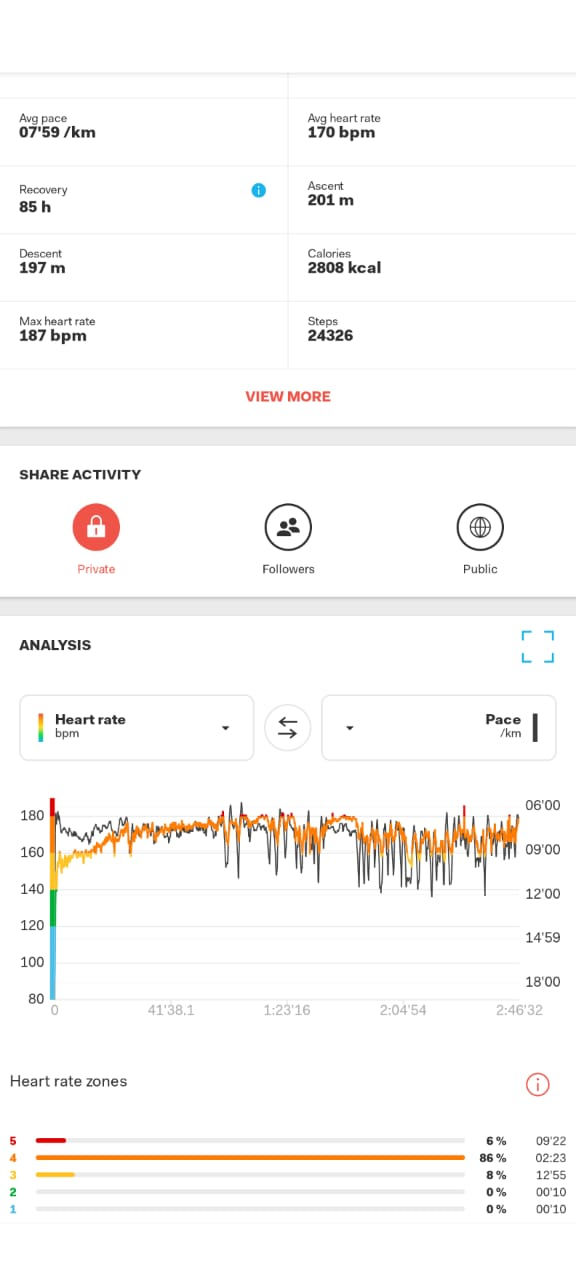
The stats of my first HM. After a steady first half, my HR shows many starts and stops because I was clearly struggling and losing pace, ending up with a nearly 8 min/km pace.
The experience was so physically taxing that I settled back into my comfort zone of sub-10K distances after this run for a LONG time. It would be another 7 years (in 2024!) before I ran another HM.
But even with the setback, something important had happened: I had proven to myself that I could complete a distance that my childhood self would have found impossible.
I just needed to be more consistent. And I was good at that :).
The Consistency Paradox (2018-2022)
The post-half-marathon years were (what I now recognize as) a textbook plateau. My consistency became even better, with 2-3 runs weekly, almost every week of the year (except if I was injured), but there was zero improvement in performance or run distance.
Each run had the same mentality: go as fast as I could manage for the distance I had planned for. The problem was, “as fast as I could manage” stopped getting faster.
| Year | Total Runs | Total distance (km) | Best 10k Pace (min/km) | 10k Pace Improvement (seconds) |
|---|---|---|---|---|
| 2013 | 21 | 152 | 7:00 | – |
| 2014 | 62 | 266 | 7:00 | 0 |
| 2015 | 20 | 90 | 7:00 | 0 |
| 2016 | 77 | 399 | 6:36 | 24 |
| 2017 | 74 | 487 | 6:35 | 1 |
| 2018 | 107 | 504 | 6:20 | 15 |
| 2019 | 104 | 512 | 6:20 | 0 |
| 2020 | 116 | 660 | 6:20 | 0 |
| 2021 | 147 | 788 | 6:19 | 1 |
In the 4 years from 2018 to 2021, I did 470+ runs and covered over 2,400 kilometers, for a grand total of 1 second per km improvement in my 10K pace.
The numbers were frustrating. I was putting in the work consistently, logging more kilometers each year, but my performance barely budged.
Each run was still a challenge. This reinforced my childhood belief that running was inherently difficult for me, combined now with the convenient excuse that I was getting older. I was definitely “Past my prime”, since I was hitting 30 now :P. I took pride in pushing through despite these perceived limitations. I never questioned if I might be training incorrectly. After all, how complicated could running be? You just… run, right?
I was still capturing everything in my fitness tracker, which dutifully recorded heart rate data that I largely ignored beyond checking the average HR to make sure I was pushing enough. As it turned out, those numbers held the key to understanding my plateau, later down the line.
Mid-2022 Onwards - Finding/Founding Netrin
I might have continued this way indefinitely, collecting data that told the same story year after year, if not for a fortuitous coincidence that would change everything. Preejith, my dear friend (from the photo above), reached out about a heart fitness company he was building called Netrin. He was looking for a technical co-founder who could help build the technology infrastructure for his vision.
The science of effective cardiovascular training wasn’t new; exercise physiologists and elite coaches had understood these concepts for decades. But this knowledge had remained largely confined to professional athletes and academic journals, rarely reaching everyday runners like me, and he wanted to change that.
Over the next three years with Netrin, I would build a solution on principles that could solve my own running challenges as well.
This post has already grown quite long, so I’ll pause here and continue the story in part two. While this first part focused on my personal journey and the data behind my plateau, the next installment will dive deeper into the science that finally unlocked my improvement. I’ll break down the specific physiological principles, training approaches, and data patterns that not only transformed my running but also became foundational to what we’re building at Netrin.
Comments